
下記のような構成でAnsibleを使ってLaravelの開発環境を作りたいと思います。
- Ansibleサーバ1台
- 開発用WEBサーバ2台
- DBサーバサーバ1台
設定ファイルとか1,2箇所ぐらいなら置換処理で良いですが、設定ファイルまるっと渡してあげたほうが楽ちんなのですべてをコード化しない方が私は好みですね。
目次
Ansibleサーバ側
ホスト名の設定
# hostnamectl set-hostname ansible.example.net
わかりやすく設定します。
SELinuxの無効化
# vi /etc/sysconfig/selinux


#SELINUX=enforcing
SELINUX=disabled
再起動にて反映しましょう!
# reboot now
モジュールのインストール
# yum -y install epel-release
# yum -y install ansible
# yum -y install MySQL-python
# yum -y install libselinux-python
# yum -y install rsync
ansibleはバージョンの違いが大きいので確認しましょうね。
# ansible --version

ansible 2.7.7
  config file = /etc/ansible/ansible.cfg
  configured module search path = [u'/root/.ansible/plugins/modules', u'/usr/share/ansible/plugins/modules']
  ansible python module location = /usr/lib/python2.7/site-packages/ansible
  executable location = /usr/bin/ansible
  python version = 2.7.5 (default, Apr 11 2018, 07:36:10) [GCC 4.8.5 20150623 (Red Hat 4.8.5-28)]
外部のサーバを操作出来るようにしよう
秘密鍵の作成を行います。
# ssh-keygen -t rsa -b 4096

Generating public/private rsa key pair.
Enter file in which to save the key (/root/.ssh/id_rsa):空Enter
Created directory '/root/.ssh'.
Enter passphrase (empty for no passphrase):空Enter
Enter same passphrase again:空Enter
Your identification has been saved in /root/.ssh/id_rsa.
Your public key has been saved in /root/.ssh/id_rsa.pub.
The key fingerprint is:
SHA256:9LhlM99R3AsM71hfoI0rRYAw00NKNw9F4HGoCagtqZY root@ansible
The key's randomart image is:
+---[RSA 4096]----+
|   .  =+B*=o. .  |
|  . .. *=* .++ o.|
| +   ..oo.. +=. =|
|+ .   o. o .+.o.o|
|...     S B....o |
|.E       + = . . |
|.       .   . .  |
|                 |
|                 |
+----[SHA256]-----+
下記の構成で作ります。
# vi .ssh/config


Host staff1-web
    HostName 192.168.100.245

Host staff2-web
    HostName 192.168.100.246

host db
    HostName 192.168.100.247
Ansibleで外部サーバを操作できるように鍵を渡します。
# ssh-copy-id staff1-web

/usr/bin/ssh-copy-id: INFO: Source of key(s) to be installed: "/root/.ssh/id_rsa.pub"
The authenticity of host '192.168.100.245 (192.168.100.245)' can't be established.
ECDSA key fingerprint is SHA256:o+UwU12FvnJsA3hjwqSw9H/ZDbINPLnrsa72UZcZvx8.
ECDSA key fingerprint is MD5:6e:d1:53:cf:1d:a2:e6:5e:4d:19:50:df:20:57:39:e2.
Are you sure you want to continue connecting (yes/no)? yes
/usr/bin/ssh-copy-id: INFO: attempting to log in with the new key(s), to filter out any that are already installed
/usr/bin/ssh-copy-id: INFO: 1 key(s) remain to be installed -- if you are prompted now it is to install the new keys
root@192.168.100.245's password:

Number of key(s) added: 1

Now try logging into the machine, with:   "ssh 'staff1-web'"
and check to make sure that only the key(s) you wanted were added.
# ssh-copy-id staff2-web
# ssh-copy-id db
Ansibleのホスト設定です。
# vi /etc/ansible/hosts


[web]
192.168.100.245
192.168.100.246

[db]
192.168.100.247
疎通確認しましょうね
# ansible all -i /etc/ansible/hosts -m ping

192.168.100.245 | SUCCESS => {
    "changed": false,
    "ping": "pong"
}
192.168.100.246 | SUCCESS => {
    "changed": false,
    "ping": "pong"
}
192.168.100.247 | SUCCESS => {
    "changed": false,
    "ping": "pong"
}
ディレクトリ作成
# mkdir -p /etc/ansible/cp.example.net/v1/{web,db}
Nginxバーチャルホストファイル作成
# mkdir -p /etc/ansible/cp.example.net/v1/web/etc/nginx/conf.d
# vi /etc/ansible/cp.example.net/v1/web/nginx/etc/conf.d/laravel.conf


server {
  server_tokens off;

  root /var/www/vhosts/cp.example.net/httpdocs/laravel/public;

  listen 80 default_server;
  server_name _;

  location / {
    index index.php index.html;
    try_files $uri $uri/ /index.php?$query_string;
  }

  location ~ \.php$ {
    fastcgi_pass unix:/var/run/php-fpm/php-fpm.sock;
    fastcgi_index index.php;
    include /etc/nginx/fastcgi_params;
    fastcgi_param SCRIPT_FILENAME $document_root$fastcgi_script_name;
  }
}
FTP設定
# mkdir -p /etc/ansible/cp.example.net/v1/web/etc/vsftpd/
# mkdir /etc/ansible/cp.example.net/v1/web/etc/vsftpd/user_conf
# touch /etc/ansible/cp.example.net/v1/web/etc/vsftpd/chroot_list
# vi /etc/ansible/cp.example.net/v1/web/etc/vsftpd/user_conf/webadmin

local_root=/var/www/vhosts
# vi /etc/ansible/cp.example.net/v1/web/etc/vsftpd/vsftpd.conf


local_enable=YES
write_enable=YES
local_umask=022
dirmessage_enable=YES
connect_from_port_20=YES
xferlog_std_format=YES
listen=YES
listen_ipv6=NO
pam_service_name=vsftpd
userlist_enable=YES
tcp_wrappers=YES
anonymous_enable=NO

ascii_upload_enable=YES
ascii_download_enable=YES
ftpd_banner=Welcome to blah FTP service.

chroot_local_user=YES
chroot_list_enable=YES
chroot_list_file=/etc/vsftpd/chroot_list

ls_recurse_enable=YES
pam_service_name=vsftpd
tcp_wrappers=YES

userlist_deny=NO


pasv_min_port=50000
pasv_max_port=50030

chroot_local_user=YES

force_dot_files=YES

xferlog_file=/var/log/vsftpd.log
xferlog_std_format=NO
log_ftp_protocol=YES


#ssl_enable=YES
#pasv_addr_resolve=YES

pasv_address=
#rsa_cert_file=/etc/pki/tls/certs/ftp.pem
#require_ssl_reuse=NO
#force_local_logins_ssl=NO
#force_local_data_ssl=NO
#port_enable=YES
#allow_anon_ssl=NO

use_localtime=YES

allow_writeable_chroot=YES

user_config_dir=/etc/vsftpd/user_conf
#listen_port=21
# vi /etc/ansible/cp.example.net/v1/web/etc/vsftpd/user_list

# vsftpd userlist
# If userlist_deny=NO, only allow users in this file
# If userlist_deny=YES (default), never allow users in this file, and
# do not even prompt for a password.
# Note that the default vsftpd pam config also checks /etc/vsftpd/ftpusers
# for users that are denied.
root
bin
daemon
adm
lp
sync
shutdown
halt
mail
news
uucp
operator
games
nobody
webadmin
変数ファイルの作成
# vi /etc/ansible/cp.example.net/v1/var_yml


---
usergroup:
  user:
    name: webadmin
    group: nginx
    password: password
app_path: "/var/www/vhosts/cp.example.net/httpdocs/laravel"
mysql_root_password: rootpassword
ssh_port: 22
mynetwork: 192.168.11.0/24
dbName: bizdb
dbUser: bizdbuser
dbPassword: bizdbpassword
コンフィグとしてわけて置くと保守性があがります。
playbookの作成
サーバを構成するレシピのようなものです。
# vi /etc/ansible/cp.example.net/v1/playbook.yml


---
- hosts: web
  become: yes
  vars_files:
    - var_yml
  tasks:
    - name: Firewalldの状態チェック
      command: systemctl is-active firewalld
      register: firewalld_result
      changed_when: False
      ignore_errors: True

    - name: Firewalldの起動, 自動起動設定
      service: name=firewalld state=started enabled=yes

    - name: Firewalld設定 80許可
      firewalld: permanent=True port=80/tcp  state=enabled immediate=true
    - name: Firewalld設定 443許可
      firewalld: permanent=True port=443/tcp state=enabled immediate=true
    - name: Firewalld設定 21許可
      firewalld: permanent=True port=21/tcp state=enabled immediate=true
    - name: Firewalld設定 50000-50030許可
      firewalld: permanent=True port=50000-50030/tcp state=enabled immediate=true


    - name: EPEL, remi リポジトリの追加
      yum:
        name:  "{{ package }}"
        state: latest
      vars:
        package:
          - epel-release
          - http://rpms.famillecollet.com/enterprise/remi-release-7.rpm
          - http://nginx.org/packages/centos/7/noarch/RPMS/nginx-release-centos-7-0.el7.ngx.noarch.rpm


    - name: Basicツールのインストール
      yum:
        name:  "{{ package }}"
        state: latest
      vars:
        package:
          - zip
          - unzip
          - git

    - name: Nginxのインストール
      yum:
        name:  "{{ package }}"
        state: latest
      vars:
        package:
          - nginx


    - name: WEBユーザの作成.1 Salt作成
      shell: "mktemp -u | awk '{print substr($0, length($0)-8+1)}'"
      register: salt

    - name: WEBユーザの作成.2 パスワード用ハッシュ作成
      shell: python -c 'import crypt; print crypt.crypt("{{ usergroup.user.password }}", "$6${{ salt.stdout }}")'
      register: hash_password

    - name: WEBユーザの作成.3 ユーザ作成
      user: name={{ usergroup.user.name }} password={{ hash_password.stdout }} groups={{usergroup.user.group}}


    - name: MariaDBクライアントインストール
      yum:
        name:  "{{ package }}"
        state: latest
      vars:
        package:
          - MySQL-python
          - mariadb

    - name: PHPをインストール
      yum:
        name:  "{{ package }}"
        state: latest
        enablerepo: remi-php71
      vars:
        package:
          - php
          - php-mysql
          - php-mbstring
          - php-gd
          - php-devel
          - php-xml
          - php-pdo
          - php-fpm
          - php-mcrypt
          - php-zip


    - name: PHPのタイムゾーン設定
      replace:
        dest: /etc/php.ini
        regexp: "{{ item.regexp }}"
        replace: "{{ item.replace }}"
      with_items:
        - { regexp: "^;date.timezone =", replace: "date.timezone = Asia/Tokyo" }
        - { regexp: "^expose_php = On", replace: "expose_php = Off" }

    - name: PHP 最大アップロード設定, メモリ設定
      replace:
        dest: /etc/php.ini
        regexp: "{{ item.regexp }}"
        replace: "{{ item.replace }}"
      with_items:
        - { regexp: "^upload_max_filesize = .*$", replace: "upload_max_filesize = 256M" }
        - { regexp: "^memory_limit = .*$", replace: "memory_limit = 256M" }

    - name: PHP-FPM設定
      replace:
        dest: /etc/php-fpm.d/www.conf
        regexp: "{{ item.regexp }}"
        replace: "{{ item.replace }}"
      with_items:
        - { regexp: "^user = apache", replace: "user = {{ usergroup.user.name }}" }
        - { regexp: "^group = apache", replace: "group = nginx" }
        - { regexp: "^listen = 127.0.0.1:9000", replace: "listen = /var/run/php-fpm/php-fpm.sock" }
        - { regexp: "^;listen.owner = nobody", replace: "listen.owner = {{ usergroup.user.name }}" }
        - { regexp: "^;listen.group = nobody", replace: "listen.group = nginx" }


    - name: PHP-FPMの起動
      systemd:
        name: php-fpm.service
        state: restarted
        daemon_reload: yes
        enabled: yes

    - name: APPフォルダ作成
      file: path="{{ app_path }}" state=directory owner=root group=root mode=0755


    - name: Nginx設定 Ansibleサーバから設定ファイルを複製
      copy:
        src: "{{ item }}"
        dest: /etc/nginx/conf.d/
        owner: root
        group: root
        mode: 0644
      with_fileglob:
      - "./web/etc/nginx/conf.d/*.conf"

    - name: Nginx設定 ユーザ指定
      replace:
        dest: /etc/nginx/nginx.conf
        regexp: "{{ item.regexp }}"
        replace: "{{ item.replace }}"
      with_items:
        - { regexp: "^user nginx;", replace: "user = {{ usergroup.user.name }};" }


    - name: Nginxの起動
      systemd:
        name: nginx.service
        state: restarted
        daemon_reload: yes
        enabled: yes

    - name: Composerのインストール
      command: "{{ item }}"
      with_items:
        - php -r "copy('https://getcomposer.org/installer', 'composer-setup.php');"
        - php composer-setup.php
        - php -r "unlink('composer-setup.php');"
        - mv composer.phar /usr/local/bin/composer
        - /usr/local/bin/composer global require laravel/installer

    - name: Laravelプロジェクトの作成
      command: /usr/local/bin/composer create-project --prefer-dist laravel/laravel {{ app_path }}


    - name: バーチャルホストディレクトリの権限変更
      file:
        path: /var/www/vhosts
        owner: "{{ usergroup.user.name }}"
        group: nginx
        recurse: yes

    - name: Laravelパーミッション設定1
      file:
        path: "{{ app_path }}/{{ item }}"
        mode: 0755
        recurse: yes
      with_items:
        - storage
        - bootstrap/cache


    - name: vsftpdインストール
      yum:
        name:  "{{ package }}"
        state: latest
      vars:
        package:
          - vsftpd


    - name: vsftpd設定 Ansibleサーバから設定ファイルを複製
      synchronize: src=./web/etc/vsftpd/ dest=/etc/vsftpd/

    - name: vsftpd設定
      replace:
        dest: /etc/vsftpd/vsftpd.conf
        regexp: "{{ item.regexp }}"
        replace: "{{ item.replace }}"
      with_items:
        - { regexp: "^pasv_address=", replace: "pasv_address={{ ansible_default_ipv4.address }}" }

    - name: vsftpd起動
      systemd:
        name: vsftpd.service
        state: restarted
        daemon_reload: yes
        enabled: yes


- hosts: db
  become: yes
  vars_files:
    - var_yml
  tasks:


    - name: EPELリポジトリの追加
      yum:
        name:  "{{ package }}"
        state: latest
      vars:
        package:
          - epel-release


    - name: MariaDB インストール
      yum:
        name:  "{{ package }}"
        state: latest
      vars:
        package:
          - MySQL-python
          - mariadb
          - mariadb-libs
          - mariadb-server
          - mariadb-devel


    - name: MySQL起動, 自動起動
      service: name=mariadb state=started enabled=yes

    - name: DBの作成
      mysql_db: name={{ dbName }} state=present

    - name: DBユーザの作成
      mysql_user: name={{ dbUser }} password={{ dbPassword }} priv={{ dbName }}.*:ALL state=present host={{item}}
      with_items:
        - '%'
        - 'localhost'
        - '127.0.0.1'


    - name: ローカル接続制限無効化
      replace: >
        dest=/etc/my.cnf
        regexp='^bind-address'
        replace='#bind-address'


    - name: MySQL再起動, 自動起動
      service: name=mariadb state=restarted enabled=yes


    - name: Apache, PHPインストール
      yum:
        name:  "{{ package }}"
        state: latest
      vars:
        package:
          - httpd
          - php
          - php-mbstring
          - php-mysql
          - php-mcrypt


    - name: phpMyAdminインストール
      yum:
        name:  "{{ package }}"
        state: latest
      vars:
        package:
          - phpMyAdmin


    - name: phpMyAdminアクセス権限の変更 ローカルネットワークのアクセス許可
      replace:
        dest: /etc/httpd/conf.d/phpMyAdmin.conf
        regexp: "{{ item.regexp }}"
        replace: "{{ item.replace }}"
      with_items:
        - { regexp: "Require ip 127.0.0.1", replace: "Require ip 127.0.0.1 {{ mynetwork }}" }


    - name: PHP 最大アップロード設定
      replace:
        dest: /etc/php.ini
        regexp: "{{ item.regexp }}"
        replace: "{{ item.replace }}"
      with_items:
        - { regexp: "^upload_max_filesize = .*$", replace: "upload_max_filesize = 256M" }
        - { regexp: "^memory_limit = .*$", replace: "memory_limit = 256M" }


    - name: Apache起動, 自動起動
      service: name=httpd state=restarted enabled=yes

    - name: Firewalldの起動, 自動起動設定
      service: name=firewalld state=started enabled=yes

    - name: Firewalld設定 3306許可 ローカルネットワークのみDBへの接続許可
      firewalld: permanent=True port=3306/tcp source={{ mynetwork }} state=enabled immediate=true
    - name: Firewalld設定 80許可 phpMyAdmin用
      firewalld: permanent=True port=80/tcp state=enabled immediate=true

    - name: Firewalldの再起動, 自動起動設定
      service: name=firewalld state=restarted enabled=yes


- hosts: all
  become: yes
  vars_files:
    - var_yml
  remote_user: root
  tasks:


    - name: yumアップデート
      yum: name=* state=latest


    - name: SELinux-1. SELinux用のPythonモジュールをインストール
      yum: name=libselinux-python state=installed

    - name: SELinux-2. SELinuxの無効化
      selinux: state=disabled
      register: selinux

    - name: SELinux-3. サーバの再起動
      shell: sleep 2 && shutdown -r now
      async: 1
      poll: 0
      become: true
      ignore_errors: true

    - name: SELinux-4. サーバの起動を待つ
      wait_for_connection:
        delay: 30
        timeout: 300

    - name: SELinux-5. 疎通確認
      ping:
チェックコマンド
構文チェック
# ansible-playbook /etc/ansible/cp.example.net/v1/playbook.yml --syntax-check

ドライラン
# ansible-playbook /etc/ansible/cp.example.net/v1/playbook.yml --check
どっかーん!サーバを一気に作っちゃお~。
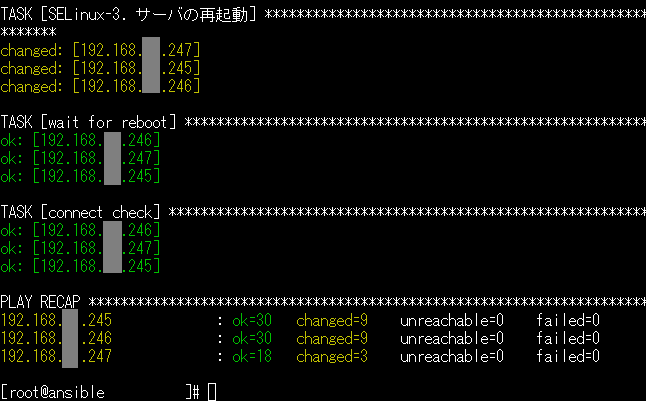
ぽちっと実行
# ansible-playbook /etc/ansible/cp.example.net/v1/playbook.yml
もりもりサーバが作られていきますね~!
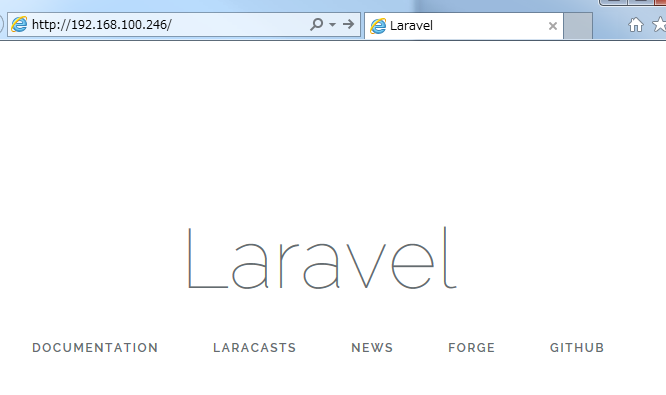
サーバにアクセスしてみちゃおう!
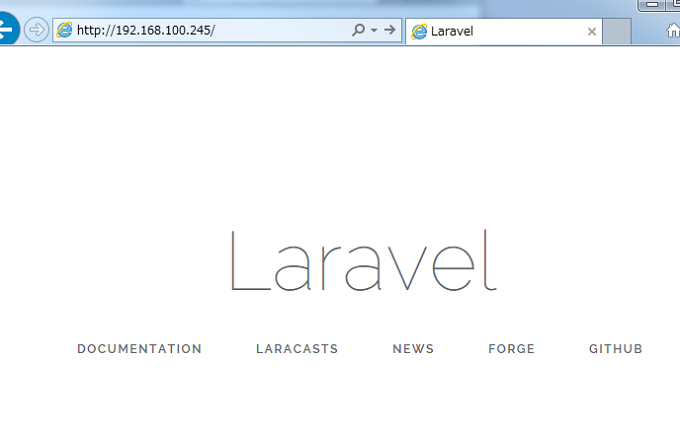
OK…!
ムムッ!
これは・・・OK!
お疲れ様です。